
When Tornadoes Strike Northern Ontario: Your Wilderness Safety Plan
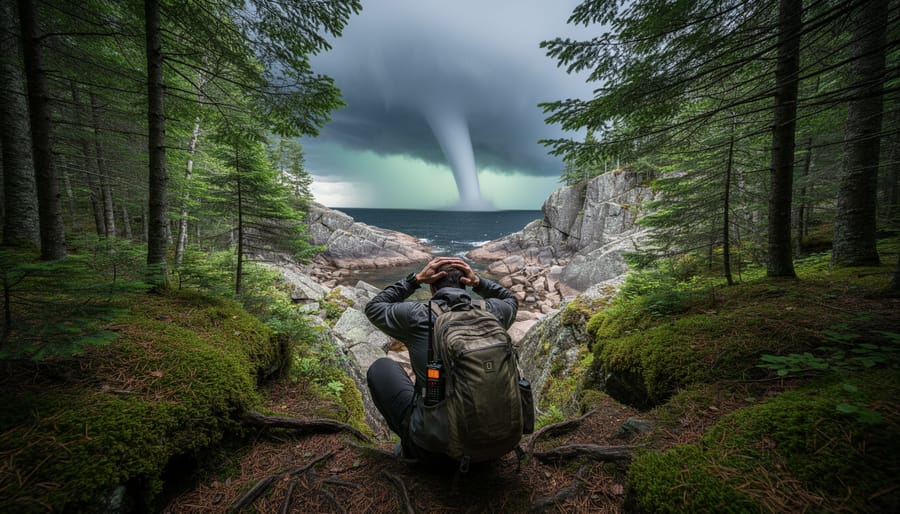
Monitor weather alerts religiously through Environment Canada’s radar system and local emergency services before venturing into Northern Ontario’s backcountry. Download offline weather apps and carry a battery-powered radio, as cell service disappears rapidly beyond Highway 11. When tornado warnings activate, identify your nearest substantial shelter immediately—dense forest groves offer better protection than open lakeshores or sparse tree coverage.
Seek low-lying terrain if caught outdoors during a tornado. Position yourself in ditches, ravines, or natural depressions while protecting your head and neck with your arms. Never shelter under highway overpasses or isolated trees, which become projectile magnets during severe storms. The vast boreal landscape may feel exposed, but reading the land saves lives.
Create an emergency action plan that accounts for Northern Ontario’s remote wilderness conditions. Pack a waterproof emergency kit containing first aid supplies, fire-starting materials, reflective signaling devices, and three days of non-perishable food. Share your detailed itinerary with someone reliable, including GPS coordinates of your camping locations and expected check-in times.
Understand that tornado risk in Northern Ontario differs dramatically from Prairie patterns. These storms develop quickly from unstable air masses colliding over the Great Lakes, giving minimal warning time. Indigenous communities throughout the region have long recognized sudden atmospheric changes—darkening skies, eerie stillness, and distinctive greenish cloud coloring—as critical evacuation signals.
Prioritize comprehensive Northern Ontario travel safety preparation before your adventure. Tornadoes remain rare but increasingly unpredictable occurrences across this wilderness. Respecting the land’s power while equipping yourself with survival knowledge ensures you experience the region’s breathtaking beauty responsibly and return home safely with unforgettable memories.
Understanding Tornado Risk in Northern Ontario’s Wilderness
Northern Ontario’s sprawling wilderness holds secrets that few travelers expect, and among them is the surprising presence of tornadoes dancing across the boreal landscape. While many associate these powerful vortices with prairie farmland, the Great Clay Belt and remote forests of Northern Ontario experience their own tornado activity, primarily between late May and early September when warm, humid air masses collide with the region’s cooler systems.
The vast expanse of wilderness means that many tornadoes touch down far from human observation, spinning through uninhabited forests where only the broken treeline tells their story. Recent decades have documented several significant events, including touchdowns near communities like Kapuskasing and Cochrane, reminding us that these powerful weather phenomena don’t respect geographic assumptions. Environment Canada’s records show that Northern Ontario experiences an average of 2-4 confirmed tornadoes annually, though experts believe many more go unreported in areas where no one witnesses them.
What makes tornado awareness particularly crucial for wilderness travelers is the fundamental isolation of Northern Ontario’s backcountry. Unlike urban centers where warning systems, sturdy buildings, and emergency services provide multiple layers of protection, remote campsites and canoe routes offer no such infrastructure. The same pristine isolation that draws adventurous souls to paddle ancient waterways and traverse endless forests becomes a vulnerability when severe weather strikes.
Indigenous communities across the region have long understood the temperament of these lands, reading weather patterns through generations of accumulated wisdom. Their respect for sudden atmospheric changes serves as a valuable lesson for visitors. In wilderness settings, you become your own early warning system, weather forecaster, and emergency responder. The nearest shelter might be hours or even days away by paddle or portage, making preparedness not just advisable but essential for anyone venturing beyond the treeline into Northern Ontario’s magnificent, unforgiving wilderness.
Safety Tip #1: Recognize the Warning Signs in Remote Locations
When you’re deep in the wilderness of Northern Ontario—whether paddling across a mirror-like lake, hiking through boreal forest, or settling into your campsite for the evening—understanding nature’s warning signals can mean the difference between staying safe and facing serious danger. Tornadoes in this region are relatively rare compared to other parts of North America, but when conditions align, they can develop with startling speed over the vast stretches of forest and water that define this landscape.
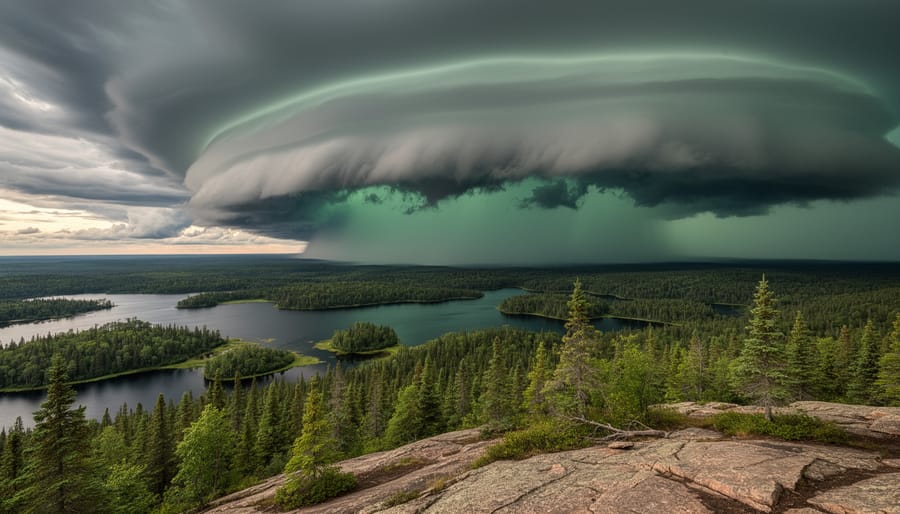
The sky itself becomes your most reliable messenger. Watch for an eerie transformation when clouds take on a distinctive dark greenish or yellowish hue—a phenomenon caused by sunlight filtering through moisture-laden storm clouds. This unsettling color often appears before severe thunderstorms capable of spawning tornadoes. On the water, this warning becomes particularly critical since you’re completely exposed with limited shelter options nearby.
Pay close attention to cloud behavior overhead. Look for formations that appear to be rotating or developing a funnel shape extending downward. What locals and Indigenous peoples of the region have long understood is that nature speaks in patterns—rotating cloud bases often precede the most dangerous conditions. If you notice clouds moving in conflicting directions at different altitudes, conditions may be ripe for tornado development.
Large hail suddenly pelting your location serves as another crucial alert. Hailstones the size of golf balls or larger indicate an exceptionally powerful storm system overhead. In remote locations, this might be your only tangible warning before a tornado forms.
Perhaps most distinctive is the sound—survivors consistently describe a freight train-like roar approaching through the forest. This continuous, thunderous rumble differs entirely from regular thunder. On Northern Ontario’s expansive lakes, sound carries differently across water, so remain vigilant if you hear anything resembling this ominous noise.
The region’s weather systems can shift dramatically within minutes, transforming a peaceful afternoon into a severe weather event. Always monitor the sky continuously during your outdoor adventures, and trust your instincts when atmospheric conditions feel wrong.
Safety Tip #2: Know Your Shelter Options in the Backcountry
When you’re paddling across a pristine Northern Ontario lake or hiking through boreal forest and weather turns threatening, understanding your shelter options can make the difference between safety and serious injury. Unlike the basements and interior rooms available in developed areas, the wilderness demands a different approach to tornado protection.
Your first instinct might be to seek shelter in your tent, but this offers virtually no protection from tornado-force winds. Canvas and nylon become dangerous projectiles rather than shields. Instead, immediately abandon your campsite and move to lower ground. In Northern Ontario’s distinctive landscape of rocky outcrops, dense forests, and wetlands, look for natural depressions, ravines, or ditches at least 100 feet away from the nearest trees. The Canadian Shield’s geology often provides rocky crevices and low-lying areas that can offer crucial protection.
If you’re canoeing when a tornado threatens, you face a particularly challenging scenario. Get to shore immediately and move away from the water. Canoes offer no protection and can become deadly projectiles. Once on land, move at least 200 feet from the shoreline and seek the lowest ground available. Northern Ontario’s marshy areas and sedge meadows, while potentially wet and uncomfortable, provide better protection than higher, exposed terrain.
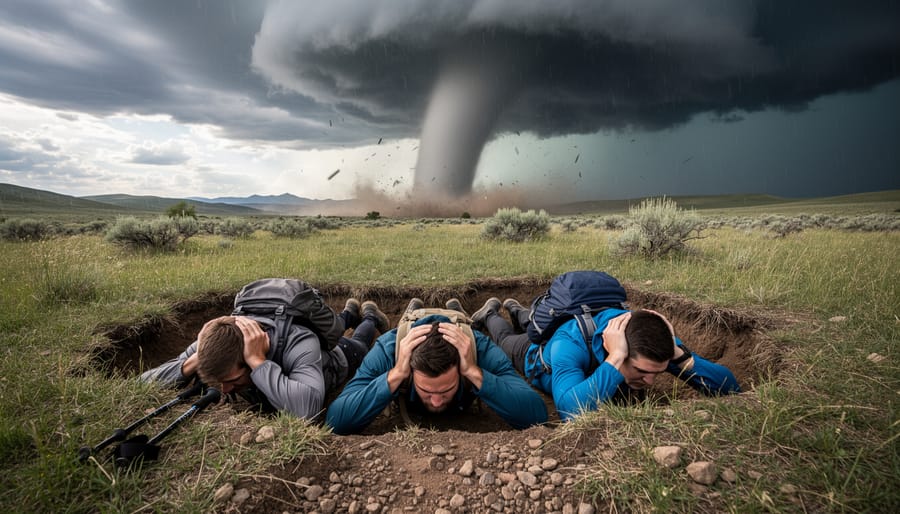
Position matters critically when you’ve found your shelter spot. Lie flat on your stomach in the depression with your hands protecting the back of your head and neck. Face down, not up. This position minimizes your profile against flying debris while protecting your most vulnerable areas. If you’re in a group, spread out rather than huddling together to reduce the chance of multiple injuries from a single piece of debris.
The region’s extensive jack pine and black spruce forests present specific hazards. These trees can snap and become airborne missiles during tornadic winds. Always position yourself in clearings or depressions away from tall timber. The Anishinaabe peoples have long understood the power of weather across these lands, respecting nature’s strength and seeking harmony with its forces. Following their wisdom means acknowledging when conditions demand humility and immediate protective action, putting safety above adventure timelines or campsite comfort.
Safety Tip #3: Pack and Prepare Weather Monitoring Tools
When you’re venturing into Northern Ontario’s vast wilderness, staying ahead of changing weather patterns can mean the difference between a memorable adventure and a dangerous situation. The region’s remote nature and unpredictable summer storms make weather monitoring tools essential components of your safety kit.
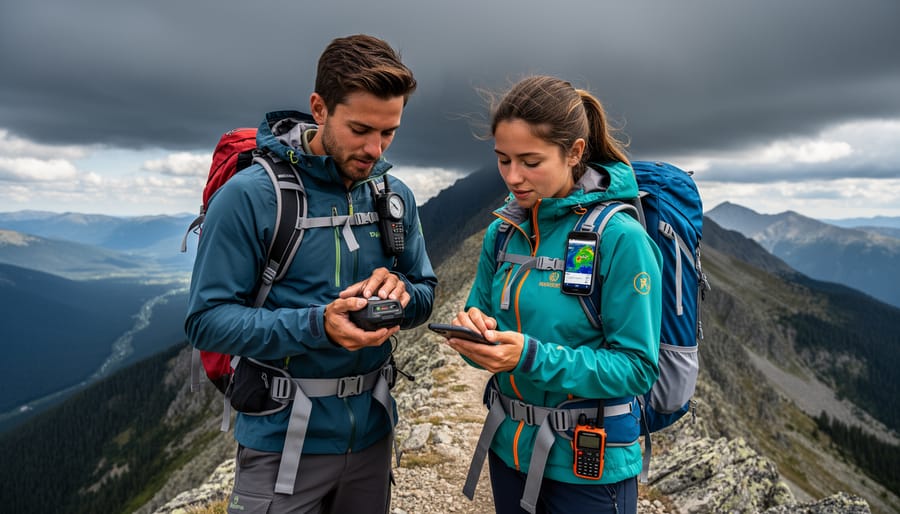
Start with a NOAA weather radio or Canadian-equivalent portable weather radio that receives Environment Canada broadcasts. These battery-powered devices provide continuous weather updates and emergency alerts, functioning independently of cell towers. In areas where cellular coverage is spotty at best, a weather radio becomes your lifeline to critical tornado warnings and severe weather information. Look for models with multiple power options, including hand-crank charging capabilities.
Satellite communicators like Garmin inReach or SPOT devices are invaluable investments for wilderness travelers. These tools not only allow two-way messaging in areas without cell service but also provide weather forecast updates directly to your device. They’re particularly crucial when exploring regions several days’ paddle from the nearest settlement, where traditional communication methods simply don’t reach.
Download weather apps with offline functionality before leaving cell coverage. Apps like Windy or Environment Canada’s WeatherCan allow you to cache radar images and forecasts. This preparation ensures you can review downloaded data even when you’re deep in the backcountry.
Don’t overlook traditional weather prediction methods respected by Indigenous communities for generations. Observing cloud formations, wind patterns, and animal behavior can provide early warnings of approaching storms. Local Anishinaabe and Cree knowledge teaches that rapidly building cumulus clouds, sudden temperature drops, and unusual bird behavior often signal severe weather.
Always check extended forecasts before your trip and establish a communication schedule with someone back home. Include checking in times and a clear plan for what they should do if you miss a check-in. Pack your weather monitoring tools alongside your essential backcountry camping equipment, and remember that redundancy in communication methods isn’t paranoia—it’s responsible wilderness travel that honors both your safety and the environment you’re exploring.
Safety Tip #4: Create and Share a Detailed Travel Plan
Before you set out into Northern Ontario’s vast wilderness, creating a comprehensive travel plan isn’t just good practice—it could save your life if severe weather strikes unexpectedly. The remote nature of the region means that help isn’t just around the corner, and a detailed itinerary becomes your lifeline when tornadoes or dangerous storms roll through.
Start by documenting your complete route, including trail names, campsites, coordinates, and estimated arrival times at each checkpoint. Share this information with at least two trusted contacts back home, and leave a copy with local park authorities or visitor centers. Your travel plan should include vehicle descriptions, license plate numbers, group member details, emergency contacts, and any medical conditions rescuers should know about. Don’t forget to specify your expected return date and establish a protocol for when your contacts should alert authorities if they haven’t heard from you.
Establish regular check-in times using satellite communicators or designated phone locations where cell service exists. Many experienced Northern Ontario travelers check in daily at predetermined times, creating a safety net that triggers alerts when something goes wrong. If severe weather forces you to alter your plans, communicate these changes immediately when possible.
The indigenous communities of Northern Ontario possess generations of accumulated knowledge about local weather patterns and land characteristics. Before your journey, connect with local First Nations tourism offices or cultural centers to gain insights about seasonal weather behavior and traditional storm warning signs. This respectful exchange not only enriches your experience but provides invaluable context about how weather moves through specific territories.
Rangers and conservation officers across Northern Ontario regularly emphasize that the travelers who fare best during emergencies are those whose whereabouts are known. Your detailed travel plan transforms you from a needle in a haystack into someone who can be located and helped when nature’s fury arrives without warning.
Safety Tip #5: Practice Post-Tornado Survival Skills
When the roar subsides and an eerie calm settles over the Northern Ontario landscape, your survival skills truly come into focus. The moments immediately following a tornado are critical, and knowing how to respond can make the difference between a challenging situation and a life-threatening emergency.
Begin by taking three deep breaths to center yourself. The psychological impact of weathering a tornado in the wilderness can be overwhelming, triggering adrenaline responses that cloud judgment. Once you’ve steadied your nerves, conduct a systematic personal injury assessment, checking for bleeding, broken bones, or signs of shock. If you’re with a group, establish verbal contact with all members and designate a meeting point if anyone became separated during the storm.
Survey your immediate surroundings with caution. Fallen trees, exposed roots, and unstable debris create hazardous terrain. Tornadoes reshape the wilderness dramatically, transforming familiar trails into obstacle courses. Use your compass or GPS device if available, as visual landmarks may have vanished. If your shelter or equipment sustained damage, prioritize securing essentials: water filtration systems, first aid supplies, and emergency communication devices.
Creating a visible signal for potential rescue teams is crucial in Northern Ontario’s vast wilderness. Use brightly colored clothing, reflective materials, or arrange rocks and branches in large geometric patterns visible from the air. Three of anything – whistle blasts, fires, or signal markers – is the universal distress call recognized by search and rescue teams.
Even in emergencies, maintain sustainable practices that honor the land and respect Indigenous teachings about living in harmony with nature. Avoid creating unnecessary damage when gathering materials for emergency shelters. If you must start a fire for warmth or signaling, contain it properly and use only deadfall wood. The Anishinaabe principle of taking only what you need applies equally in crisis situations.
Document the tornado’s path and your location details when possible. This information helps meteorologists and emergency services while contributing to regional weather pattern understanding. Remember, Northern Ontario communities are resilient and interconnected – help will come, and your preparation will see you through.
Building Your Northern Ontario Storm Safety Kit
When you’re venturing into Northern Ontario’s magnificent backcountry, preparing for severe weather events like tornadoes becomes an essential part of your wilderness preparedness strategy. Your storm safety kit should be compact yet comprehensive, designed to handle the unexpected while you’re exploring remote landscapes far from immediate help.
Start with the fundamentals: a weatherproof first aid kit containing bandages, antiseptic supplies, pain relievers, and any personal medications stored in waterproof containers. Include emergency shelter materials like a durable tarp, emergency blanket, and paracord for securing makeshift protection if your tent is damaged. A weather radio with hand-crank charging capability keeps you connected to Environment Canada alerts even when batteries fail.
Signaling devices are crucial in Northern Ontario’s vast wilderness. Pack a whistle, signal mirror, and waterproof flare kit to help search teams locate you if separated from your group. Store critical documents including park permits, emergency contacts, and medical information in double-sealed waterproof bags.
Don’t overlook sustainability in your preparations. Choose reusable water purification methods and biodegradable supplies that respect the pristine environment. Local Indigenous communities have long understood the importance of preparing for nature’s unpredictability while minimizing environmental impact. Consider packing high-energy, non-perishable foods that require minimal waste packaging.
Keep your kit accessible in a brightly colored dry bag, making it easy to grab during sudden weather changes. This comprehensive approach ensures you’re ready to face whatever Northern Ontario’s dynamic weather systems bring your way.
While tornadoes remain a rare occurrence in Northern Ontario’s vast wilderness, understanding severe weather protocols enriches your preparedness for any adventure that awaits in this magnificent region. The skills you develop through tornado awareness extend far beyond a single weather phenomenon, building resilience and confidence for navigating the untamed beauty of Canada’s north country.
As you plan your journey through ancient boreal forests, pristine waterways, and landscapes shaped by millennia of natural forces, remember that responsible wilderness exploration means respecting both the grandeur and the power of nature. The Indigenous communities who have thrived here for generations understand this balance intimately, approaching the land with reverence and careful preparation.
Let these safety practices inspire a deeper connection with Northern Ontario’s wilderness rather than create fear. Pack your weather radio alongside your sense of wonder. Study the skies with both caution and appreciation. Share knowledge with fellow travelers while treading lightly on this precious ecosystem.
Your adventure awaits in a region where caribou still roam, northern lights dance across endless horizons, and every lake tells an ancient story. Embrace it fully, prepare thoughtfully, and become part of Northern Ontario’s legacy of sustainable, mindful exploration. The wilderness is calling—answer it with respect, knowledge, and an adventurous spirit ready for whatever nature brings.
