
Aulavik National Park: Arctic Wildlife, Muskox Herds, and Remote Tundra Ecosystems
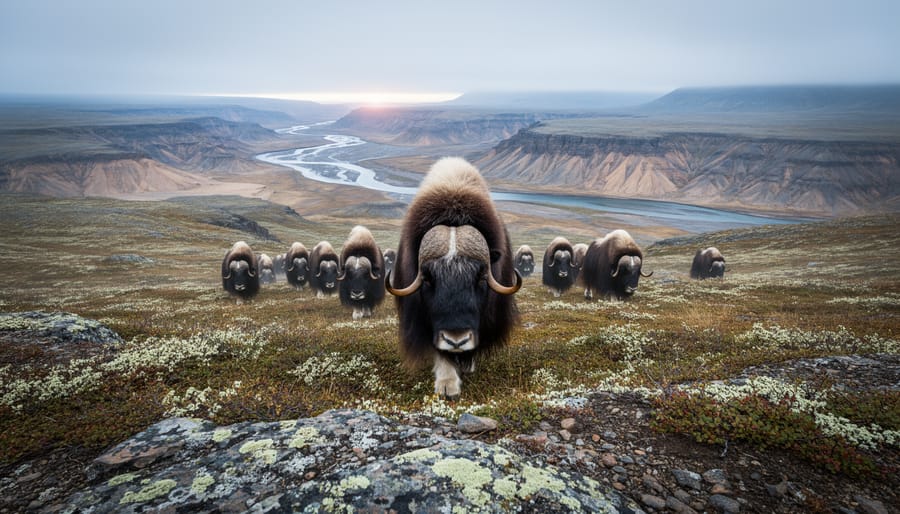
Aulavik National Park protects more than 12,000 square kilometres of arctic lowlands on the north end of Banks Island in the Northwest Territories, where you’ll find the world’s highest density of muskoxen roaming across landscapes that shift from fertile river valleys to polar deserts, dramatic badlands, and windswept seacoasts. This remote wilderness draws serious adventurers and wildlife enthusiasts to one of Canada’s most pristine arctic ecosystems, where muskoxen outnumber all other large mammals and the tundra reveals an unexpected richness of life adapted to some of the planet’s harshest conditions.
The park’s name, Aulavik, means “place where people travel” in Inuvialuktun, the language of the Inuvialuit people who have navigated these lands for millennia. Their deep knowledge of seasonal patterns, wildlife movements, and survival strategies shaped how humans have understood this arctic environment for generations. That cultural connection to the land adds profound meaning to any journey here, reminding visitors that this isn’t untouched wilderness but rather a landscape where indigenous peoples have thrived and traveled with purpose.
Banks Island’s rolling tundra supports an extraordinary concentration of wildlife. Muskoxen dominate the scene, with the park hosting thousands of these shaggy arctic survivors whose ancestors walked alongside woolly mammoths. The most recent population surveys counted more than 45,000 non-calf muskoxen across Banks Island, with over 11,000 within park boundaries during peak summer months. Watching herds move across the open tundra, their prehistoric silhouettes framed against midnight sun or autumn aurora, offers a glimpse into ice age ecology that persists nowhere else on Earth with such abundance.
Where Aulavik National Park Protects the Arctic Frontier
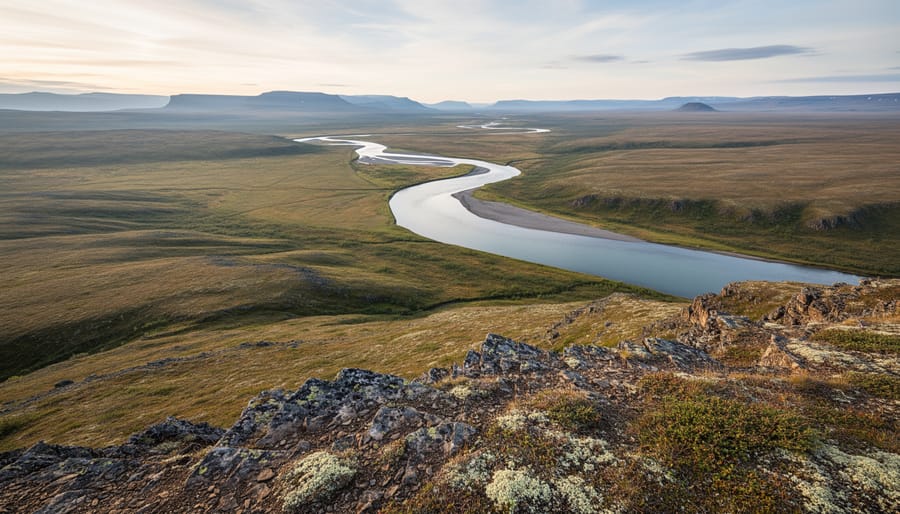
Banks Island rises from the Arctic Ocean as Canada’s fifth-largest island and the westernmost fragment of the Canadian Arctic Archipelago. This massive polar landmass, positioned north of mainland Northwest Territories and west of Victoria Island, extends over 70,000 square kilometres of tundra where ice-sculpted valleys meet endless horizons. Here, at the island’s northern edge overlooking the Beaufort Sea, Aulavik National Park protects more than 12,000 square kilometres of pristine arctic wilderness.
The park’s name carries deep meaning in Inuvialuktun, the language of the Inuvialuit people who have traveled these lands for millennia. Aulavik translates to “place where people travel,” acknowledging the ancestral routes that crisscrossed this terrain long before national boundaries existed. The name honors both movement and destination, reflecting how the Inuvialuit navigated these valleys in pursuit of caribou, muskoxen, and other resources that sustained life in the polar north.
To grasp Aulavik’s remoteness, consider that no roads connect to Banks Island. The closest settlement, Sachs Harbour, sits 250 kilometres south on the island’s opposite coast, home to roughly 100 residents. From there, charter flights carry the rare visitor northward over seemingly infinite tundra, crossing river systems and rolling hills until the park’s northern reaches appear. This is the High Arctic at its most raw and uncompromising, where the midnight sun circles the horizon in summer and winter darkness settles for months, where temperatures plunge and wind reshapes the land with relentless force.
The Arctic Ecosystem: From River Valleys to Polar Deserts
Fertile River Valleys and Tundra Lowlands
The Thomsen River carves through Aulavik’s heart, creating the world’s northernmost navigable river and a ribbon of fertility in an otherwise austere landscape. Its broad valley supports dense stands of arctic willow, sedge meadows, and cotton grass that explode into growth during the brief arctic summer. Muskoxen congregate along these lowlands in remarkable numbers, drawn by the lush vegetation that thrives where snowmelt and permafrost-fed streams sustain plant life well into August.
These tundra lowlands function as the park’s ecological engine. While much of Banks Island receives minimal precipitation, the Thomsen valley captures moisture and shelters vegetation from relentless arctic winds. The result is a patchwork of microhabitats where ground squirrels burrow, nesting birds raise young, and caribou graze alongside muskox herds. In July, the valley transforms into a surprisingly verdant corridor, with wildflowers dotting the sedge meadows and shore birds working the river edges.
The gentle topography of these lowlands creates ideal conditions for wildlife viewing. Muskoxen don’t vanish into terrain features here; they stand silhouetted against rolling hills, often in groups exceeding twenty animals. The valley’s fertility supports the density that makes Aulavik unique among arctic parks.
Coastal Cliffs, Badlands, and Arctic Deserts
Beyond the verdant corridors of the Thomsen River valley, Aulavik reveals its harsher face. The park’s northern reaches and elevated terrain transition into landscapes that test the limits of life in the Arctic, places where rock, wind, and ice sculpt forms that seem more lunar than terrestrial.
Along the coastline, sheer cliffs drop dramatically to the Beaufort Sea, their layered sedimentary faces telling stories written over millions of years. These coastal bluffs stand defiant against pack ice and storm waves, providing nesting ledges for seabirds during the brief summer months. The interface between land and sea here is raw and uncompromising, a meeting of elemental forces where ice, water, and stone engage in their ancient struggle.
Moving inland, the terrain buckles into badlands, deeply eroded hills and gullies carved by millennia of freeze-thaw cycles and spring melt. These rugged formations, striped with exposed sediment layers, create a maze of ridges and ravines that appear utterly barren from a distance yet harbor surprising pockets of hardy vegetation in sheltered microclimates.
The polar desert areas represent the most extreme environments within the park’s boundaries. Here, precipitation is so scarce that these regions qualify as true deserts, receiving less moisture annually than parts of the Sahara. Sparse cushion plants cling to gravelly substrate, and the ground is often bare rock or frost-shattered stone. Summer temperatures may briefly climb above freezing, but the growing season is measured in mere weeks.
These austere landscapes complete Aulavik’s environmental spectrum, proving that arctic wilderness encompasses far more than endless tundra. They’re reminders that even in a place known for its wildlife abundance, large swaths remain almost entirely devoid of visible life, beautiful in their desolation.
Muskox Herds: The World’s Highest Density Population
Banks Island’s windswept tundra shelters an extraordinary natural phenomenon: the densest congregation of muskoxen anywhere on Earth. Aulavik National Park stands as the epicenter of this population, hosting these ancient arctic survivors in numbers that dwarf concentrations found across the rest of the Arctic archipelago and circumpolar regions. Muskox estimates from 1994 and 1998 documented 11,200 animals within the park boundaries during early July 1994, while the broader Banks Island population reached 45,833 non-calf muskoxen by 1998. These figures represent a wildlife success story decades in the making, transforming this remote island into the planet’s premier muskox stronghold.
The abundance stems from near-perfect ecological conditions. Banks Island’s relatively flat terrain, nutrient-rich river valleys, and expansive lowland tundra provide ideal grazing across seasons. Muskoxen are supremely adapted grazers, using their specialized lips and teeth to crop sedges, grasses, and willows close to the ground. Unlike caribou that migrate vast distances, muskoxen remain year-round, pawing through snow to reach winter forage. Their thick qiviut undercoat, eight times warmer than sheep’s wool, allows them to withstand temperatures plunging past minus forty degrees while expending minimal energy.
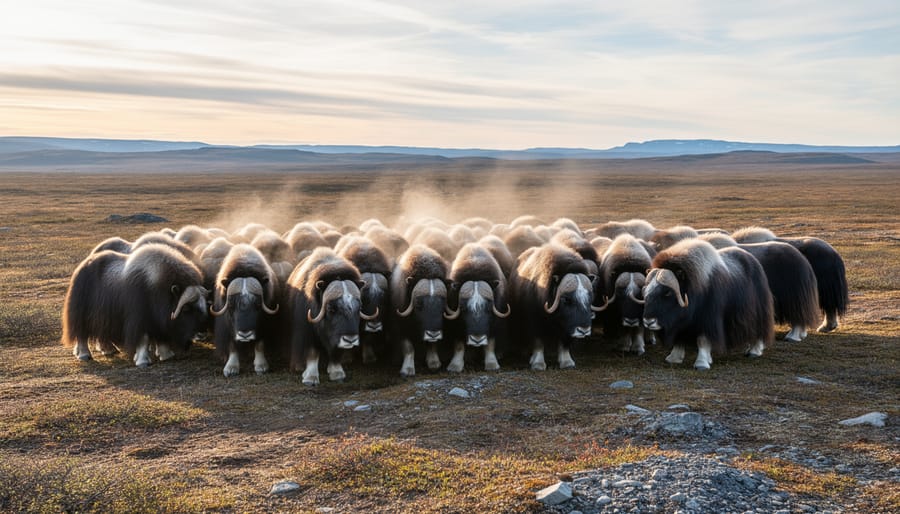
These prehistoric-looking mammals, unchanged for millennia, display fascinating social structures. Herds typically range from a handful to several dozen animals, though larger aggregations form during summer calving periods. Dominant bulls protect the group by forming defensive circles when threatened, with horns outward and calves sheltered inside, a formation that proves effective against wolves but tragically made them vulnerable to historic overhunting. Watch for this defensive posture if you encounter a herd; it signals stress, and you should back away immediately.
- The 11,200 muskoxen counted in Aulavik during July 1994 represented the highest density recorded in any protected area globally.
- Peak viewing opportunities occur during summer months when animals frequent river valleys and coastal areas for optimal grazing.
- Bulls become more visible and vocal during late August rutting season, though this also makes them more unpredictable.
- Maintain a minimum distance of 100 meters; use binoculars or telephoto lenses rather than approaching closely.
- Never position yourself between animals and their escape route, and retreat slowly if a herd forms a defensive circle.
Muskoxen serve as ecosystem engineers across Aulavik’s tundra. Their grazing patterns shape plant communities, creating patches of disturbed ground where different species colonize. Their dung fertilizes nutrient-poor soils, and their trails create pathways used by foxes, hares, and ground-nesting birds. Wolves hunt muskoxen opportunistically, targeting calves and weakened adults, maintaining population health through natural selection.
Witnessing these magnificent animals against Aulavik’s vast arctic backdrop remains one of North America’s most profound wildlife experiences. The sight of a herd moving across rolling tundra, their long guard hairs swaying like dark curtains, connects you to an ice age lineage. They appear simultaneously gentle and formidable, peaceful grazers that transform into a unified defensive force within seconds. The sheer concentration of animals here offers viewing possibilities unmatched anywhere else, though the remoteness and expense of reaching Aulavik means these encounters remain rare privileges reserved for serious arctic adventurers willing to journey to the true edge of wilderness.
Wildlife Beyond the Muskoxen
While muskoxen dominate the landscape, Aulavik’s arctic tundra supports a remarkable diversity of wildlife adapted to one of Earth’s most challenging environments. The park’s varied terrain, from river valleys to coastal cliffs, creates distinct habitats where different species thrive across the seasons.
Peary caribou, smaller and paler than their mainland cousins, roam the park in small groups. These rare arctic caribou have adapted to survive on sparse tundra vegetation and can dig through snow to reach lichens and sedges. Their populations fluctuate with harsh winter conditions, making sightings particularly rewarding for visitors.
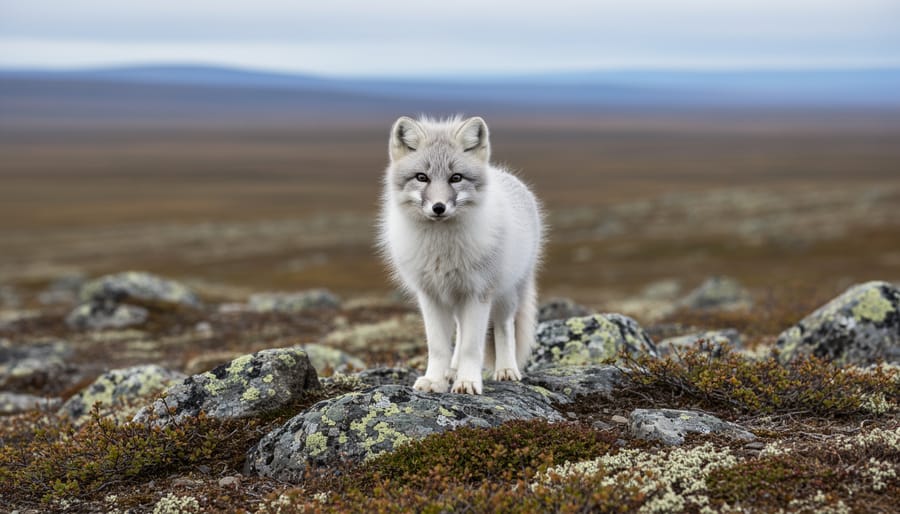
Arctic foxes patrol the tundra year-round, their coats shifting from brown in summer to brilliant white in winter. You’ll often spot them near lemming colonies, their primary food source. Collared lemmings themselves play a crucial role in the ecosystem, their boom-and-bust population cycles ripple through the entire food web, affecting predators from foxes to snowy owls.
Arctic wolves, though less common than on the mainland, occasionally travel through Aulavik hunting caribou and muskoxen. Arctic hares, wearing white camouflage nearly year-round at this latitude, bound across the tundra in small groups, feeding on willows and woody plants.
The park explodes with birdlife during the brief arctic summer. Snow geese, king eiders, and oldsquaw ducks arrive to nest in the relative abundance of the Thomsen River valley. Rough-legged hawks and peregrine falcons hunt the tundra, while sanderlings and other shorebirds probe the mudflats. Long-tailed jaegers harass smaller birds, and snowy owls scan for lemmings from rocky perches.
Along Aulavik’s northern coastline, marine mammals punctuate the Arctic Ocean. Ringed seals haul out on ice floes, while bearded seals dive for bottom-dwelling prey. During summer, beluga whales sometimes appear in coastal waters, and the occasional polar bear wanders the shoreline hunting seals.
Wildlife activity shifts dramatically with the seasons. Summer brings constant daylight, frantic breeding, and concentrated activity. Winter plunges the park into darkness and temperatures that can drop below -40°C, when only the hardiest residents remain active. Spring and fall migrations transform the park as birds arrive and depart in waves, and caribou move between seasonal ranges.
Planning Your Arctic Journey to Aulavik
Reaching Aulavik National Park demands months of advance preparation and a significant commitment to wilderness self-reliance. This is not a park you casually visit. Banks Island sits in the Arctic Ocean, hundreds of kilometres from the nearest road system, accessible only by chartered aircraft from Inuvik or Sachs Harbour. Most visitors fly into the Thomsen River valley, where small aircraft can land on gravel bars during dry conditions, but weather delays are common and you must build flexibility into your travel plans.
Before you book your trip contact Parks Canada directly to understand current permit requirements, safety protocols, and access considerations. Regulations and conditions change, and the agency provides essential briefings on wildlife encounters, Leave No Trace principles in fragile tundra, and emergency procedures. You’ll need to demonstrate wilderness competence and carry comprehensive gear for arctic conditions, even in summer.
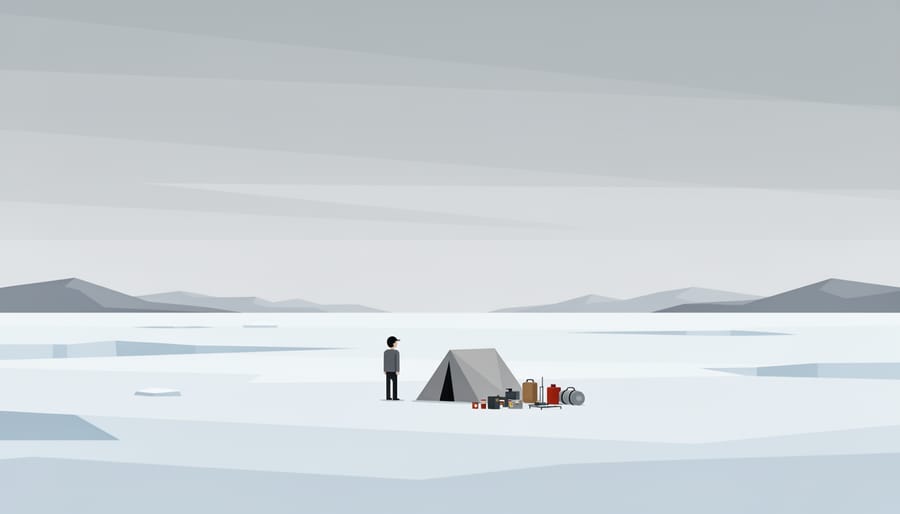
The brief July-to-August window offers the mildest weather, with temperatures ranging from just above freezing to around 10°C, but snow, ice, and high winds can strike at any time. Your packing tips for Aulavik should prioritize cold-weather survival: four-season tents capable of withstanding gales, sleeping systems rated for well below zero, multiple layers of insulating clothing, and waterproof outer shells. You’ll carry everything you need for the duration of your stay, including all food, fuel, and camping supplies.
Wilderness safety in the Arctic requires specific skills: navigation without trails or landmarks, river crossing techniques for icy waters, bear awareness protocols, and contingency plans for extended weather delays. Satellite communication devices are essential, not optional. Many visitors engage Inuvialuit guides who bring irreplaceable knowledge of the land, weather patterns, wildlife behavior, and cultural context, guidance that transforms a challenging expedition into a profoundly richer experience while ensuring you respect indigenous protocols and contribute to local communities.
Indigenous Heritage and Inuvialuit Connection
Banks Island has been home to the Inuvialuit people for thousands of years, and their connection to what is now Aulavik National Park runs far deeper than modern boundaries suggest. The park’s name itself comes from Inuvialuktun, meaning “place where people travel,” a testament to the generations who have traversed these lands for hunting, fishing, and seasonal migration. This wasn’t empty wilderness before designation, it was a lived landscape, rich with knowledge passed down through oral tradition.
The Inuvialuit harvested muskoxen, caribou, and arctic char from the Thomsen River, adapting their movements to the rhythms of wildlife and weather. Archaeological sites within the park boundary reveal centuries of occupation, from hunting camps to tool-making locations. That legacy shapes how the park operates today. Aulavik is co-managed between Parks Canada and the Inuvialuit, ensuring that traditional ecological knowledge informs conservation decisions and that Indigenous culture remains central to the park’s identity, not an afterthought.
If you’re planning a visit, understanding this relationship matters. The land sustains both wildlife and people, and respectful travel means acknowledging Inuvialuit stewardship. Some areas may hold cultural significance that isn’t immediately apparent to outsiders. Hiring Inuvialuit guides doesn’t just improve safety in this extreme environment, it offers insight no guidebook can match, from reading weather patterns to understanding animal behavior shaped by millennia of observation.
This isn’t tokenism. The Inuvialuit Final Agreement of 1984 established rights that predate the park’s creation in 1992, including continued harvesting and input on management. When you explore Aulavik, you’re a guest on land still connected to living communities. Approach with humility, follow protocols established by Parks Canada and Inuvialuit leadership, and recognize that true wilderness protection here depends on honoring the people who never stopped caring for it.
Common Questions About Visiting Aulavik National Park
How do I get to Aulavik National Park?
The only way to reach the park is by chartered aircraft from Inuvik or Sachs Harbour, as there are no roads or scheduled flights to this remote corner of Banks Island. You’ll need to arrange your own transportation well in advance and expect significant costs for chartered flights into the arctic wilderness.
When is the best time to visit?
The brief arctic summer from late June through August offers the most accessible conditions, with 24-hour daylight, milder temperatures, and active wildlife. Outside this window, extreme cold, darkness, and unpredictable weather make travel exceptionally challenging even for experienced arctic travelers.
What wildlife will I see in Aulavik?
Muskoxen are virtually guaranteed, the park holds the world’s highest density of these shaggy arctic survivors. You’ll also have good chances of encountering arctic foxes, Peary caribou, arctic hares, lemmings, and dozens of migratory bird species along the river valleys and coastlines.
Do I need a guide to visit Aulavik?
While not legally required, hiring an experienced guide familiar with arctic conditions and wildlife behavior is strongly recommended for safety and to navigate this trackless wilderness. Local Inuvialuit guides bring invaluable knowledge of weather patterns, wildlife movements, and cultural context that transforms the experience.
Beyond these basics, you’ll need to contact Parks Canada directly for current permit requirements, camping regulations, and mandatory trip registration procedures. This isn’t a park you can simply show up to, every visit requires extensive advance planning.
Gear demands are serious. You’ll need a four-season tent rated for high winds, a sleeping bag comfortable to minus ten Celsius even in summer, multiple clothing layers including wind-proof shells, bear spray, emergency communication devices like a satellite phone or GPS messenger, water filtration systems, and enough food for your entire stay plus several days of contingency supplies. There’s no infrastructure, no cell service, and no rescue services standing by.
Can you camp anywhere? Generally yes, following Leave No Trace principles, but you must be completely self-sufficient. The tundra is fragile, avoid trampling vegetation, camp on durable surfaces when possible, and pack out everything you bring in. River valleys offer some shelter from relentless winds, but be prepared for weather to change suddenly and dramatically at any moment.
Aulavik National Park stands as a testament to what true wilderness means in the 21st century. Few places on Earth offer such profound remoteness coupled with such extraordinary wildlife abundance. The sight of thousands of muskoxen moving across arctic lowlands, the silence of polar deserts broken only by wind, and the midnight sun illuminating tundra that stretches to every horizon, these experiences exist nowhere else with this intensity.
This isn’t a destination for casual travelers. Getting to Banks Island demands serious commitment, thorough preparation, and respect for an environment that tolerates no mistakes. Yet for those willing to meet the challenge, Aulavik delivers something increasingly rare: genuine wilderness encounter in one of the planet’s last intact ecosystems.
The park’s 12,000 square kilometres protect more than landscape. They preserve the world’s densest muskox population, safeguard critical habitat for species found nowhere else, and honor the deep connection between the Inuvialuit people and their ancestral lands. Every visitor carries responsibility to tread lightly, follow indigenous guidance, and leave this arctic sanctuary as pristine as they found it.
If you’re ready to venture beyond the familiar, to witness wildlife spectacles that predate human civilization, and to test yourself against the arctic’s raw beauty, Aulavik waits. The tundra remembers everyone who walks it. Make sure your footprint is one of respect.
