
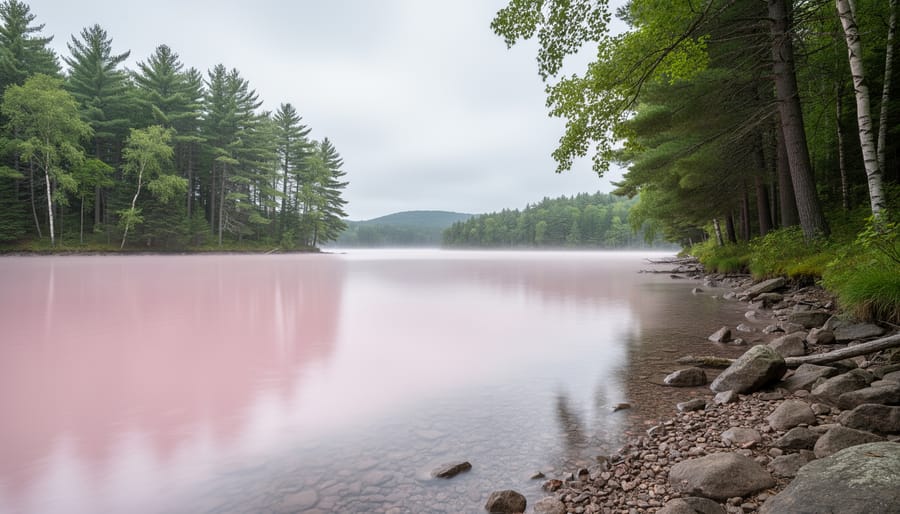
Where Pink Lake Actually Is (And Why You Can’t Swim in It)
Pink Lake sits in Gatineau Park, just across the Ottawa River in Gatineau, Quebec, making it one of the most accessible natural wonders for adventurers traveling from Northern Ontario. The most direct route brings you to the Pink Lake parking lot off the Gatineau Parkway, where a three-season trail and lookout await those ready to witness this rare ecological treasure.
Despite its evocative name, the lake earns its title not from color but from the Pink family who once lived nearby. What truly sets this meromictic lake apart is its unique stratified water system, where layers never mix, creating conditions found in fewer than two dozen lakes worldwide. The indigenous Algonquin peoples have long recognized these lands as significant, and today’s conservation efforts honor that legacy through strict protection measures.
Visitors should know upfront that Pink Lake’s fragile ecosystem requires respect. Swimming, boating, and watercraft of any kind are prohibited, and pets cannot accompany you on the trail. These rules exist to preserve the lake’s delicate microbial communities and prevent invasive species introduction. During winter months, when the Gatineau Parkway transforms into a cross-country ski trail, the Pink Lake Trail closes entirely, making spring through fall the ideal window for your visit. Planning ahead ensures you experience this geological marvel while treading lightly on protected land.
Finding Pink Lake: Gatineau Park’s Hidden Gem
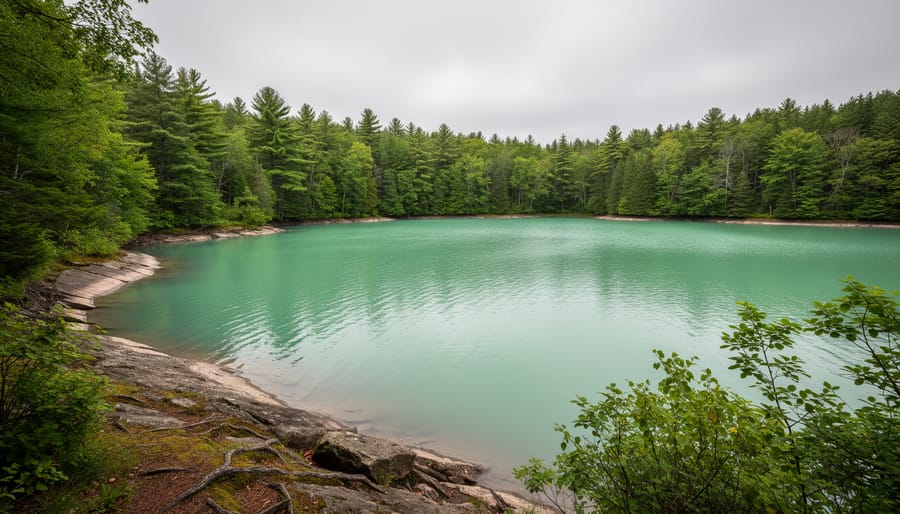
Pink Lake sits tucked into the wooded hills of Gatineau Park, just across the Ottawa River from Canada’s capital. Despite what its name suggests, this isn’t a remote wilderness destination, Pink Lake in Gatineau Park lies remarkably close to urban Ottawa, making it an accessible escape for travelers from across Ontario and Quebec.
For visitors coming from Northern Ontario, you’ll find Pink Lake about 350 kilometers southeast of North Bay, roughly a four-hour drive through the Ottawa Valley. The lake itself sits within Gatineau Park’s 361 square kilometers of protected Gatineau Hills terrain, positioned on the Quebec side of the National Capital Region. This means crossing provincial lines, but the journey follows straightforward routes through Highway 17 and Highway 417 corridors that connect Northern Ontario to the capital.
The most direct access to Pink Lake is from the Pink Lake parking lot, accessible from the Gatineau Parkway. This dedicated lot serves as your starting point for the short walk to the lake’s edge and lookout point. From downtown Ottawa, you’re looking at a twenty-minute drive west into Gatineau Park. The parkway itself winds through mixed forest and offers several access points to different park features, but the clearly marked Pink Lake lot puts you closest to this particular attraction.
The Gatineau Parkway becomes your primary navigation landmark once you’ve crossed into the park. Unlike wilderness lakes scattered across Northern Ontario’s backcountry, Pink Lake’s location within an established provincial park means maintained roads, marked parking, and designated trails. You won’t need a portage or a boat launch, just follow the parkway signs to the lot.
What Makes Pink Lake Worth the Journey
The Science Behind the Stillness
Pink Lake earns its protected status because of what lies beneath the surface. Unlike typical lakes where seasonal mixing circulates oxygen and nutrients from top to bottom, Pink Lake’s waters remain permanently stratified in distinct layers. The deeper waters haven’t mixed with the surface in roughly 10,000 years, essentially since the last ice age.
This rare meromictic condition creates separate chemical worlds stacked on top of each other. The bottom layer stays oxygen-free and rich in dissolved minerals, while the upper layer supports life as you’d expect. Between them sits a boundary zone where unique bacterial communities thrive in conditions found in few other places on Earth. Scientists study these ancient waters to understand everything from climate history to how life adapts to extreme environments.
Here’s why this matters for visitors: even minor disturbances can disrupt this delicate layering. A swimmer kicking through the water or a kayak paddle stirring the depths could introduce oxygen where it hasn’t existed for millennia, potentially destroying bacterial communities that can’t be replaced. The trail system and viewing platform let you experience this natural laboratory while keeping its chemistry intact.
Indigenous Stewardship and Modern Conservation
The Algonquin peoples have moved through the Gatineau region for thousands of years, long before Pink Lake received its current name or scientific designation. Their relationship with the land was built on careful observation and seasonal understanding, practices that recognized the delicate balance of water systems and surrounding forests. Traditional knowledge emphasized reading the landscape for what it could sustainably provide while leaving ecosystems intact for future generations.
Modern conservation at Pink Lake draws directly from these principles of minimal disturbance and long-term thinking. Indigenous stewardship approaches inform how park managers maintain the trail system, establish viewing areas, and enforce protective restrictions. The decision to keep visitors on designated paths and prohibit any water contact mirrors traditional practices of treating certain places as observational rather than extractive spaces.
This collaboration between ancestral wisdom and contemporary science creates a conservation model that respects both the lake’s ecological rarity and its cultural significance, ensuring Pink Lake remains undisturbed for those who follow.
Access Rules Every Visitor Must Know
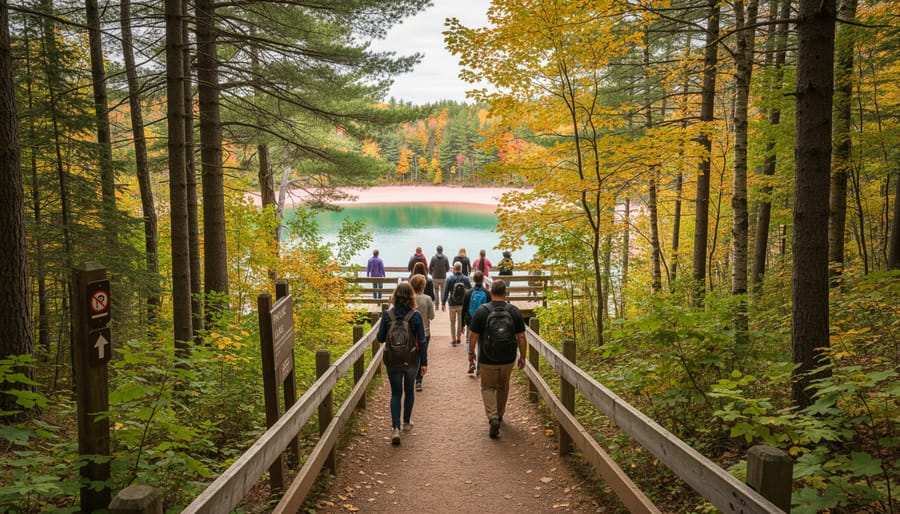
Before you even set foot on the trail, understand that Pink Lake’s rules exist for one reason: this meromictic lake is irreplaceable. The boundaries aren’t suggestions, they’re essential protection for an ecosystem that took thousands of years to develop and could be damaged in minutes.
The three-season trail runs roughly one kilometre around the lake, with a lookout point offering the best views of the water below. It’s straightforward walking, suitable for most fitness levels, but you’ll stay on the designated path at all times. Cutting across terrain or wandering down to the shore disrupts fragile plant life and accelerates erosion that threatens the lake’s delicate layering.
No swimming or watercraft rules are absolute and enforced. You won’t dip a toe in this water, launch a kayak, or float anything on the surface. Pink Lake’s unique stratification means the lower layers remain undisturbed, creating conditions found in fewer than three dozen lakes worldwide. Any water contact introduces contaminants, disrupts temperature gradients, and risks mixing the separated layers that make this lake scientifically remarkable.
Dogs and other pets cannot accompany you. Period. Even well-behaved animals on leashes pose risks, waste introduces nutrients that fuel algae growth, paws disturb soil along the trail, and wildlife encounters stress the native species that depend on this protected zone. Leave your furry companions at home or choose another Gatineau Park destination that permits them.
You’ll also find barriers and fencing at certain points along the trail. These mark particularly sensitive areas or unstable ground near the shore. Respect them. Every shortcut or peek over the edge contributes to erosion that narrows the buffer between human activity and the lake itself.
Pack out everything you bring in. There are no garbage bins at the trailhead, intentionally. You’re expected to carry your waste with you, ensuring nothing leaches into the surrounding environment.
These restrictions might feel limiting, but they’re precisely why Pink Lake remains worth visiting. You’re seeing something genuinely rare because previous visitors followed the same rules you’re being asked to honour.
Planning Your Visit: Seasonal Considerations
Pink Lake reveals different facets of its character throughout the year, and timing your visit makes a real difference. The three-season trail operates from spring through fall, giving you roughly eight months to explore the shoreline path and reach the lookout point. This extended window means you’re not racing against a narrow tourist season, you can choose when crowds are lighter or when the surrounding forest puts on its best show.
Spring brings awakening forest energy, with emerging leaves creating that fresh green canopy overhead. Summer offers the fullest views and warmest weather for the 2.5 kilometer loop, though you’ll share the trail with more visitors. Fall transforms the experience entirely. The mixed hardwood forest surrounding Pink Lake erupts in vibrant reds, oranges and golds from late September through mid-October, creating stunning reflections on the lake’s surface that justify the journey alone.
| Season | Trail Status | Access Notes |
|---|---|---|
| Spring/Summer/Fall | Open | Lookout accessible, parking lot available |
| Winter | Closed | Gatineau Parkway becomes cross-country ski trail |
Winter changes everything. The Pink Lake Trail closes when Gatineau Parkway transforms into a groomed cross-country skiing route, shifting the park’s purpose entirely. You can’t drive to the parking lot or hike the trail during these months. If you’re committed to winter wilderness exploration in the region, the parkway’s ski trails offer their own rewards, but Pink Lake itself becomes off-limits for viewing.
For first-time visitors from Northern Ontario making the drive, aim for late May through October. You’ll catch the trail in full operation, avoid the ski season closure, and have flexibility to choose your preferred weather window. Early mornings in any season bring calmer conditions and fewer people, letting you appreciate this meromictic lake’s stillness without distraction.
Getting There from Northern Ontario
From most Northern Ontario communities, reaching Pink Lake means a full-day road trip covering 400 to 700 kilometers depending on your starting point. Sudbury sits roughly 450 kilometers from Gatineau Park, translating to about five hours of traveling by car via Highway 17 and Highway 417. Travelers from Thunder Bay face a more ambitious 1,400-kilometer journey best split over two days with an overnight stop.
Route planning matters here. Highway 17 east toward Ottawa offers reliable services and rest areas, but fuel up before long stretches and check road conditions during shoulder seasons when weather shifts quickly. Once you reach the Ottawa-Gatineau region, follow the Gatineau Parkway to the Pink Lake parking lot, your navigation system may try routing you through residential areas, but the parkway provides the most direct access.
For day trips, consider what to pack beyond typical hiking gear: binoculars enhance your lookout experience, a reusable water bottle keeps you hydrated without contributing waste, and layers adapt to microclimates around the lake. Pack out everything you bring in, including organic waste like apple cores that don’t belong in this sensitive ecosystem.
Carpooling reduces your environmental footprint on these longer drives. Splitting the journey with fellow adventurers cuts per-person emissions while making the hours pass faster, embodying the sustainable travel practices that protect places like Pink Lake for future explorers.
Exploring Responsibly: Leave No Trace at Pink Lake
Pink Lake’s delicate meromictic layers took thousands of years to form and can be disrupted by a single careless moment. The designated trail system exists to protect these layers from erosion and contamination, so stick to the marked paths even when they seem to take you farther from the shoreline. Those wooden barriers and viewing platforms aren’t suggestions, they prevent soil compaction and sediment runoff that would cloud the water and interfere with the rare chemical stratification below.
Pack out everything you bring in, including organic waste like apple cores and banana peels that can introduce non-native nutrients and disrupt the lake’s careful balance. The same wilderness safety principles you’d apply in the Northern Ontario backcountry matter here, perhaps even more so given Pink Lake’s scientific significance. If you’re visiting during shoulder seasons when fewer people are around, resist the temptation to approach the water’s edge. The restrictions protect not just the visible surface but the invisible microbial communities and oxygen-free zone beneath that make this lake internationally important. Your respect for these guidelines ensures researchers can continue studying this rare natural laboratory and future visitors can witness the same ecological wonder you’re experiencing today.
Pink Lake stands as a testament to the quiet wonders scattered across the borderlands where Northern Ontario meets Quebec. This single meromictic lake, tucked into Gatineau Park’s green folds, reminds us that the most remarkable places often demand something from their visitors: patience, respect, and a willingness to observe rather than consume.
The journey from Northern Ontario to Pink Lake isn’t just about crossing provincial lines. It’s about recognizing that these fragile ecosystems exist because people chose protection over exploitation. The same wilderness ethic that shapes responsible travel through the boreal forests of Northern Ontario applies here, maybe even more so given Pink Lake’s rarity.
As you explore this region, let Pink Lake represent what’s possible when we prioritize preservation. The lookout offers what you need: a clear view, fresh air, and the knowledge that your restraint keeps this place intact. Every restricted activity, every closed trail in winter, every barrier you respect ensures that someone twenty years from now can stand where you stood and see what you saw. That’s the real reward of seeking out places like this.
